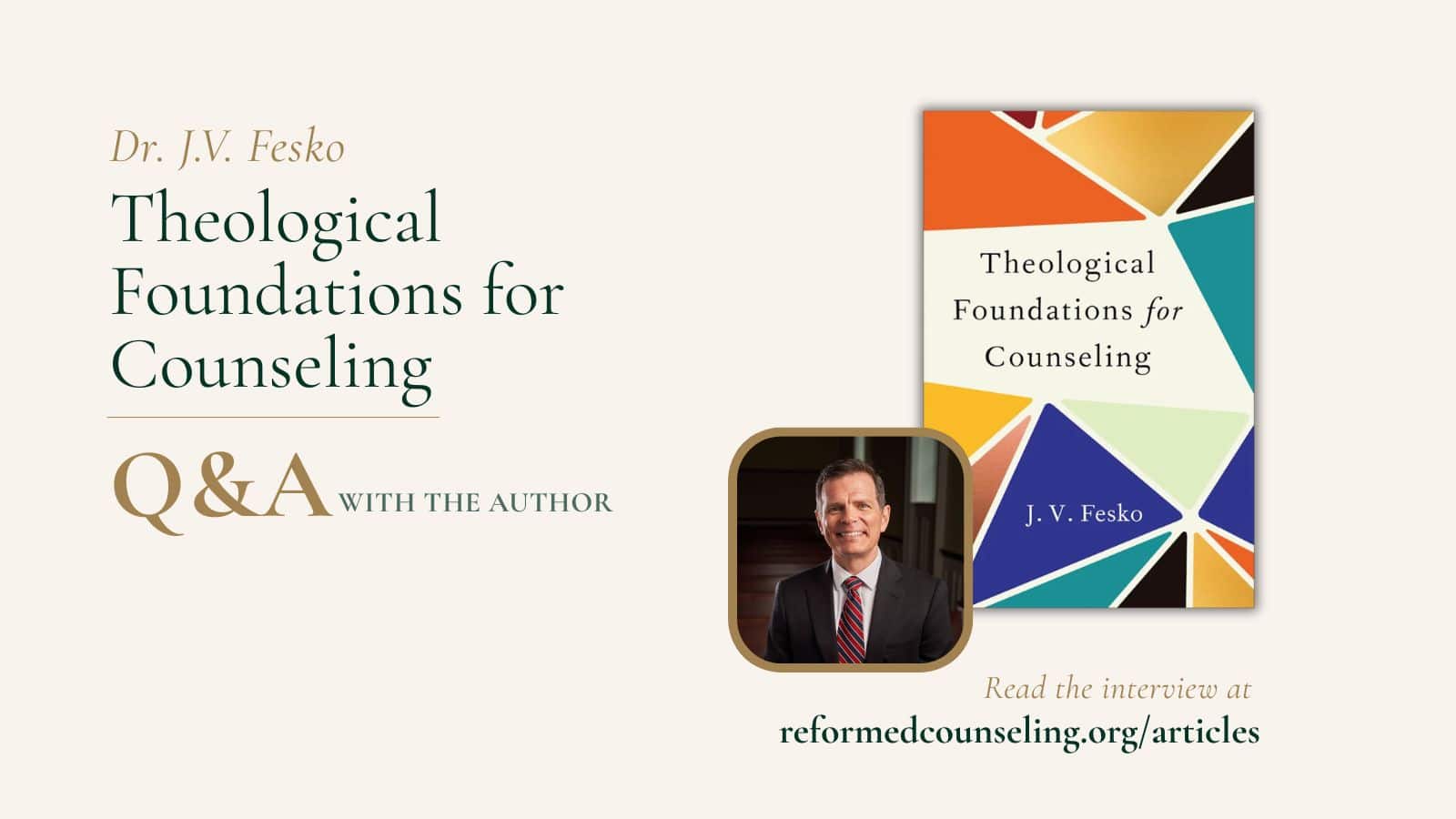
We had the privilege of conversing with Dr. J.V. Fesko’s on his most recent publication, Theological Foundations for Counseling.
To purchase a copy of Theological Foundations for Counseling, click here.
Jared Poulton: Dr. Fesko, take a moment and introduce yourself to our audience.
J. V. Fesko: I am the Harriet Barbour professor of Systematic and Historical Theology at Reformed Theological Seminary in Jackson, Mississippi. I am an ordained minister in the Orthodox Presbyterian Church. I’ve served in ministry for nearly thirty years as a church planter, pastor, and now full-time professor. I have written around forty books on various theological subjects and strive to write material that edifies the church, whether for the academy or for the person in the pew. I love reading classic Reformed theology and sometimes feel like I get lost in the sixteenth and seventeenth centuries. One of my favorite theologians is Francis Turretin, a theologian whose prose is dense, but substance is rich. His work is insightful, decidedly Reformed but also catholic. That is, he is committed to catholic (that is, universal, not Roman Catholic) teaching in line with the historic confessional Reformed faith.
Poulton: You have written many works in the areas of systematic theology and historical theology. What inspired you to write a book within the discipline of counseling?
Fesko: Some might think that my book on counseling strays from the topic of systematic and historical theology, but the title of my book provides a good starting point: Theological Foundations for Counseling. In other words, my book is chiefly about the theology that undergirds counseling. I think of my book as a theological compass that points people in the right direction rather than being a book solely on counseling. My book is very much about systematic theology and historical theology as I mine the Scriptures for theological truths that are relevant for counseling, such as the doctrine of the covenants, natural theology, and union with Christ. I also bring historical theology to bear to show readers how topics such as faith and reason, or the sufficiency of Scripture, have been historically used and applied in the Christian life by Reformed theologians.
Poulton: Throughout this work, you express the concern that some of the theological concepts informing contemporary approaches to Christian counseling are inconsistent with the Reformed tradition. What are some essential characteristics of a Reformed approach to counseling?
Fesko: In my reading of counseling literature many have wonderful intentions but they do not show that they have interacted with what the historic Reformed tradition has taught about key theological doctrines, such as the sufficiency of Scripture, the relationship between faith and reason, or general and special revelation. From a certain stand point, this lack of interaction is understandable, as many want to focus on issues specifically related to counseling. However, sometimes it’s necessary to revisit what our historic Reformed tradition has said about these topics so we can ensure that we articulate these doctrines accurately. For example, the doctrine of the covenants has a lot to say about foundational issues for counseling. The doctrine of the covenant of works teaches that God created all human beings in his image and likeness, wrote his laws upon their hearts, and gave them the ability to fulfill this law (Gen. 1:28; 2:15-17; Hos. 6:7; Rom. 2:14-16; 5:12-21; Westminster Confession 7:1-2). This means that all people have a knowledge of who God is and the basics of moral right and wrong. No one can claim that they do not know that lying or stealing is wrong. This gives us important theological truth as we counsel people.
Poulton: Some readers may be surprised that you critique how biblical counselors articulate the doctrines of the sufficiency of Scripture and general revelation, even concluding that Powlison and others have a biblicistic understanding of these doctrines (67–69). What is behind your concern here?
Fesko: Sometimes in the church we can use terms and concepts but we might struggle with giving a definition of the term. This is especially true with the doctrine of the sufficiency of Scripture. Many counselors have the correct inclination to ascribe sufficiency to Scripture but they do not interact with any historic Reformed definitions of the doctrine. The historic confessional Reformed tradition has never taught that the sufficiency of Scripture means that we only use the Bible in living the Christian life. This is a biblicist approach. When we take only the Bible and sit in isolation as we individually read, interpret, and apply it to others apart from consulting what others have taught, we slip into biblicism. For example, the apostle Paul says that in the wake of Christ’s ascension, he gave gifts to the church in the form of teachers and pastors (Eph. 4:11-12). Just as the teachers in the day of Nehemiah “helped the people to understand the Law” by reading from the law and then they “gave the sense, so that the people understood the reading” (Neh. 8:7-8), Christ’s gifts of teachers and pastors throughout the ages can help us understand the word of God. These teachers are not infallible, and we always have the need to hold their explanations up to the light of Scripture because it is “the supreme judge by which . . . [the] opinions of ancient writers, doctrines of men, and private spirits, are to be examined” (Westminster Confession 1:10). This is sola Scriptura at work. Nevertheless, we impoverish our theology when we fail to consider the wisdom of our theological tradition. To say, then, that the doctrine of sufficiency means that we do not need anything else in this life except the Bible fails to account for how our own tradition has defined the doctrine.
In the examples I cite in my book, those referenced do not interact with standard definitions of the doctrine of sufficiency. Within its original sixteenth century context, Reformed theologians defined the sufficiency of Scripture over and against the claims of the Roman Catholic magesterium, which argued that the church was necessary for the understanding of Scripture. The French Confession (1559), for example, states that the Scriptures contain “all that is necessary for the service of God and for our salvation, it is not lawful for men, nor even for angels, to add to it, to take away from it, or to change it” (art. 5). This statement has in view the Roman Catholic practices that do not find their origins in Scripture but rather in church tradition, such as the authority of the Pope or the use of images in worship. It does not mean, however, that we should never consult sources outside of Scripture. Samuel Rutherford, one of the Westminster divines, for example, explains: “Scripture is our rule, but (1) not in miraculous things; (2) not in things temporal, as community of goods; (3) not in things literally expounded, as to cut off our hands and feet; (4) not in things of art and science, as to speak Latin, to demonstrate conclusions of astronomy. (5) It is not properly our rule in circumstances that are but natural occurrences of time, place, person, and such like.”
To put this in the simplest of terms, there are truths that God has imbedded in the creation outside of Scripture that are relevant for the Christian life, and Rutherford points us to them. We do not look to the Bible to teach us astronomy, but rather we look to the heavens to learn about such subjects. To look to the heavens does not diminish the sufficiency of Scripture because God never intended for the Bible to teach us about astronomy. The Bible says nothing, for example, about the speed of light. Understanding the nature of the sufficiency of Scripture and how it has been historically expressed, then, is of great importance when it comes to living the Christian life, and especially when it comes to matters related to counseling.
Poulton: The doctrine of common grace has been at the center of recent counseling debates. How would you define common grace, and what is the role of common grace in counseling as well as Christian engagement with secular psychological resources?
Fesko: Theologians have historically distinguished between God’s special grace, the favor he shows elect but fallen sinners in their salvation solely through Christ, and the common grace that he universally dispenses throughout the whole creation. Through God’s common grace he preserves the creation and gives people, believer and unbeliever, the ability to know truth. This means that Christians can appeal to the truth that unbelievers speak and write in every area of the Christian life, including counseling. John Calvin explains our ability to appeal to common grace truths in this way: “Therefore, in reading profane authors, the admirable light of truth displayed in them should remind us, that the human mind, however much fallen and perverted from its original integrity, is still adorned and invested with admirable gifts from its Creator. If we reflect that the Spirit of God is the only fountain of truth, we will be careful, as we would avoid offering insult to him, not to reject or condemn truth wherever it appears. In despising the gifts, we insult the Giver.” Regardless of the source, we should always seek and employ God’s truth. Some might worry that unbelievers will distort and corrupt the truth. The truth of the matter is, even Christians can distort or misunderstand the truth. This is why we must always take anything we encounter, whether from a believer or unbeliever, and hold it up to the light Scripture, which as the Westminster Confession states is “the supreme judge” in the Christian life (WCF 1:10). Again, this is sola Scriptura at work.
A prime example of common grace insight comes from recent research done by secular psychologists on the negative impact of smart phones and social media. Smart phones and social media have had a significantly detrimental effect upon the lives of children and teens, especially young girls. Do we ignore this data, research, and its significance because it has come from secular psychologists? Or can we say that they give good counsel regarding keeping children away from social media until they are about 16 years old? To employ common grace insights from those outside the church does not mean we must believe any and every claim they make, but neither should we automatically dismiss them. Like Calvin counsels, if all truth comes from God, then we do not want to “insult the Giver” but rather carefully weigh and consider as much evidence as possible as we hold it up to the light and authority of Scripture.
Poulton: You have previously written on apologetics and critiqued a presuppositional approach in Reformed Apologetics (Baker Academic, 2019). What parallels do you see between these debates in apologetics and current debates between integrationists and biblical counselors?
Fesko: There are significant parallels between the apologetics and counseling debates largely driven by the philosophical concept of worldview. Many Christians (such as counselors and apologists) regularly invoke the concept of worldview. In fact, biblical counselors who claim to preclude reference to or reliance upon secular psychology invoke the concept of worldview. Yet, have they given sufficient thought to the idea that the worldview concept originates from Immanuel Kant, a secular philosopher? Kant argued that worldviews originated from a single concept and explained everything in the world. Worldviews begin with a solitary idea from which an entire worldview was deduced. The concept was quickly wedded to the doctrine of Darwinian evolution to say that each race has an utterly incompatible (incommensurable) worldview. Christian theologians adopted the Kantian idea of worldview to argue that the Christian faith stands in utter antithesis to other religious worldviews. I believe the worldview idea largely (though not exclusively) came through presuppositional apologetics, and presuppositional apologetics was a key foundational movement undergirding the biblical counseling project. Few have asked the question of how the concept of worldview has positively or negatively influenced the debate between different schools of counseling. Moreover, few have gone behind the advent of worldview and asked, How did Reformed theologians understand counseling and the Christian life prior to the rise of Kant’s worldview concept? These are important issues that certainly merit careful thought and attention.
Poulton: How do you hope that this work will bless churches, pastors, and counselors?
Fesko: At a minimum, my prayer is that my book will cause people to return to the Scriptures to rethink fundamental assumptions about counseling. Why does the Bible repeatedly turn our attention to the creation, for example? Why was Moses willing to take counsel from his unbelieving father-in-law, Jethro (Exo. 18) about how to govern God’s people? I hope that the book will also encourage readers to revisit the works of the historic Reformed tradition. We have a rich trove of resources that few consult in debates about counseling. We should let the fresh breeze of past centuries blow through our minds, as C. S. Lewis once wrote. Our forebears are not inerrant and they certainly made mistakes, but they don’t necessarily make the same mistakes that we make today and thus they can teach us important scriptural truth. In the end, I hope that my book serves the church by providing a helpful theological compass as people seek to navigate issues related to counseling and living the Christian life.