
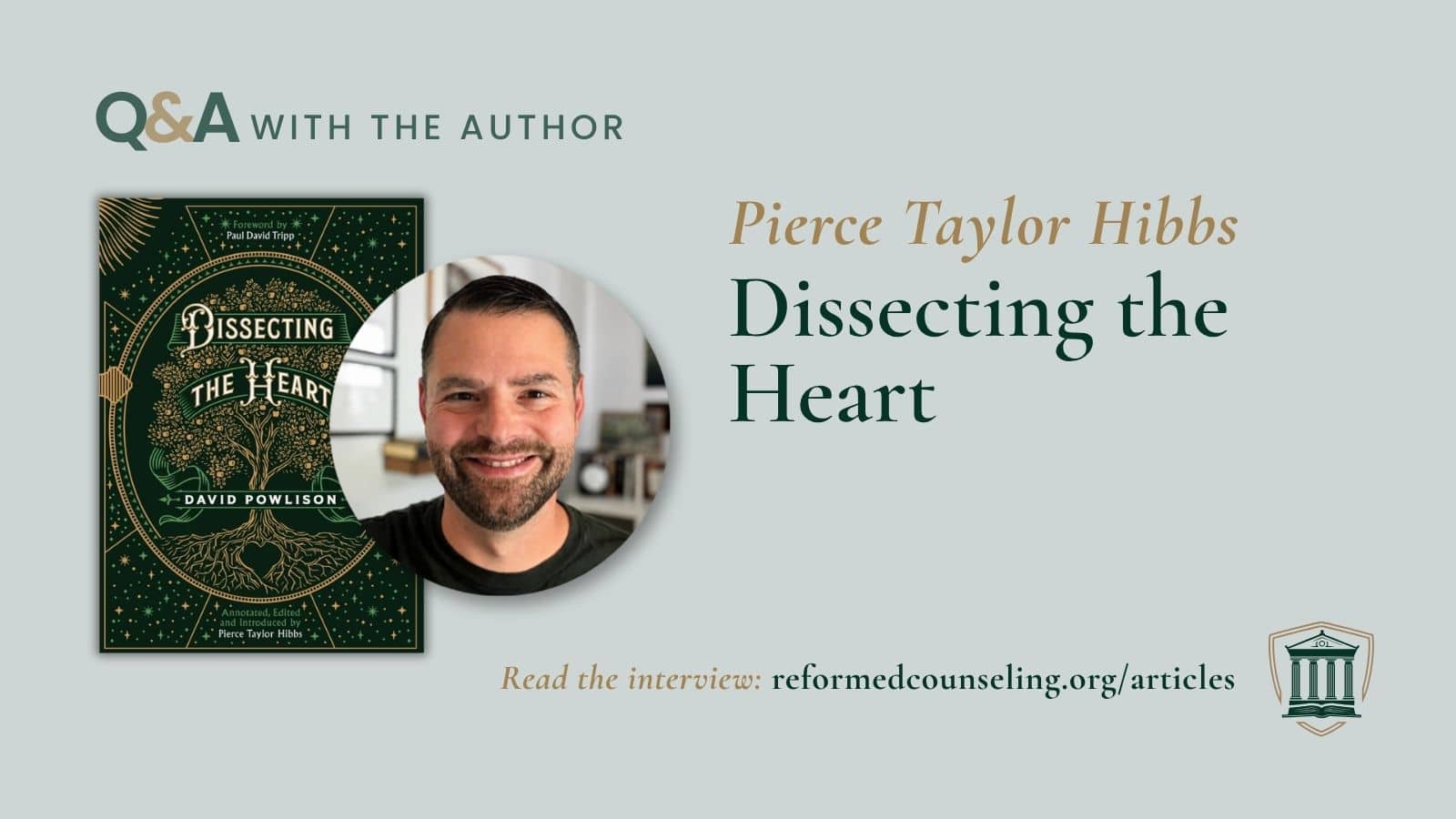
We had the privilege of conversing with Pierce Taylor Hibbs about his latest publication, Dissecting the Heart. Pierce Taylor Hibbs serves as a Senior Writer at Westminster Theological Seminary in Glenside, Pennsylvania.
To pre-order a copy of Dissecting the Heart, click here.
Jared Poulton: Take a moment and introduce yourself to our audience as a Christian and a writer.
Pierce Taylor Hibbs: I came to faith as an anxious seven-year-old. My father was a Bible Fellowship pastor at a tiny church in the Poconos of Pennsylvania. But I didn’t fully own my faith until my father passed away from brain cancer in 2004. Following that experience, I started battling acute anxiety and was treated for an anxiety disorder in the middle of college. That’s when I started reading the Bible incessantly. I had been an avid lover of literature since high school, but the Bible was in a different category—still somewhat distant to me—and the Spirit had not yet opened my eyes to the beauty and power of Scripture. Once he did, I couldn’t get enough. Biblical faith became a real lifeline, so I thought and prayed about going to seminary. This was a major shift, since I studied professional writing as an undergrad and had just started a master’s degree in writing. But God had other plans. In the fall of 2008, I started studying at Westminster Theological Seminary in Glenside, PA.
At Westminster, I earned an MAR degree, focusing on systematic theology, and then began working full-time at the Center for Theological Writing, tutoring and teaching writing classes. I also did a lot of my own writing: blog posts, articles, and books. Having a deep fascination with language and the Trinity, I picked up Vern Poythress’s In the Beginning Was the Word (2009) and had regular meetings in his office. There we talked about the work of the Christian linguist Kenneth L. Pike, his former teacher. With the Lord’s guidance, I decided to pursue a ThM degree at Westminster that centered on Pike’s language theory, the thesis of which culminated in the book The Trinity, Language, and Human Behavior (P&R). Building on that project in the same year, I published The Speaking Trinity & His Worded World (Wipf & Stock) and Finding God in the Ordinary (Wipf & Stock). Since then, I’ve had a passion for the potency of words and the craft of written theology, but I was, even then, preparing my heart and mind to address a core spiritual issue: anxiety.
My first popular-level book was about dealing with anxiety as a Christian: Struck Down but Not Destroyed (2020). At that point, I was a theologian with one foot in the mental health world, so I started engaging with David Powlison at CCEF (before he passed away in 2019) and writing articles for the Journal of Biblical Counseling. That’s when I fell in love with practical theology. Practical theology is the sort that enters someone’s bloodstream, binds to the cells, and produces change from the inside out.
Since then, the Lord has blessed me by allowing me to write almost thirty books, and I have a growing joy of communicating all the things God has been teaching my stubborn heart. Currently, I serve as Senior Writer and Communication Specialist at Westminster, where I continue writing books, articles, essays, and (when no one’s looking) fiction and poetry. I also do a lot of editing.
As a father of three, I get the joy and challenge of putting theology into practice at home, alongside my wife, Christina. We’re in the midst of shepherding our kids in light of God’s word and enjoying their wonder at the spectrum of everyday experiences. We love listening to them and talking about the great books we read together.
Our basset hound, Buddy, enjoys listening to no one and barking at everyone.
Poulton: This new book, Dissecting the Heart, gives contemporary audiences another opportunity to learn from the widely respected counselor, teacher, and scholar David Powlison (1949–2019). What inspired you to partner with Westminster Seminary Press on this new project?
Hibbs: I was always a fan of David’s work and had the privilege of conversing with him on multiple occasions. As a writer, I loved the way he crafted words. He was the one who helped me develop a two-part article for the Journal of Biblical Counseling, “Words of Counsel.” His personality exuded wisdom and kindness as he worked out the theology he loved in counseling scenarios. He was also an ardent reader of Cornelius Van Til, whom we both loved, and that had a significant impact on his theology.
Westminster Seminary Press had access to many of David’s seminary lectures that only lived in audio format in Westminster’s archives. They asked me if I’d be willing to take a selection of those lectures, edit them, introduce them, and then annotate them. To do that, I would need to read all of David’s books and many of his articles. While that sounds like “work” to some people, it sounded like fun to me. And I underestimated how much I would learn from him. For over a year, I lived in his head. His calm and lucid voice still resonates in my memory. He opened my eyes to the influence of secular psychology in the church, the nature of spiritual warfare, and how theology can meet people in the midst of real and crippling problems. He’s one of my theological heroes. I’ve imbibed so much of his thinking and emphases. Perhaps the greatest thing I’ve learned from him is the centrality of the heart to all of life—whether that’s through motivation, desire, self-deception, or custom-designed idolatry in the twenty-first century.
The result of all that study and reflection is Dissecting the Heart. I hoped it would be a one-stop shop to David’s thought and theology.
Poulton: Since the book is titled Dissecting the Heart, what did David Powlison understand about people, the heart, and human motivation that separated his approach to counseling from secular psychology?
Hibbs: Having worked in psychiatric hospitals for several years before coming to seminary, David knew firsthand what the mental health world was like: what it could offer and what it couldn’t. I was struck by his experiences there, which he recounts in some chapters of Dissecting the Heart. He noticed that secular psychologists were always trying to go deeper, to get at the roots of human problems. But they couldn’t. Why? Because they could not focus on the heart: that was the Bible’s territory. Psychologists such as Sigmund Freud, Carl Rogers, and B. F. Skinner attempted to explain human behavior and propose solutions to human problems. But they didn’t agree with each other. In fact, there was no fundamental agreement on what ailed humanity. That was, in one sense, very troubling; in another, it was encouraging to Christians. It meant that the attempts of the most educated psychotherapists would still fall short of Scripture’s analysis of the human condition: that our hearts are lost and restless apart from the living triune God. And all human problems draw us either toward or away from that God. Powlison once remarked that, as he discovered this and was running towards the church to express the good news, he was flabbergasted to see so many people in the church running away in the opposite direction, toward secular psychology. It was a bizarre experience for him.
So, he decided to take up the torch of biblical theology left by Jay Adams and, with others, work out the next phase in the history of biblical counseling. His aim was to bring the riches of Scripture to bear on the most painful, raw, and rudimentary problems: anxiety, depression, anger, sexual brokenness. And his work was getting attention. Books such as Seeing with New Eyes (2003) and Speaking Truth in Love (2005) gained traction with readers looking for Scripture’s wisdom applied to everyday spiritual problems. David had a gift for showing readers how cutting God’s word could be. Here was a counselor who knew his Bible and the intricacies of human struggle, who knew the field of secular psychology and the way in which Scripture spoke into the soul. David had learned how the Bible dissects our hearts, showing that what ails humans is something deep within them, not something outside them.
For David, every person is an image-bearer of God who is worshiping something or someone. The heart is the organ directing that worship. He wrote, “The core insanity of the human heart is that we violate the first great commandment” (Dissecting the Heart, 3). We love other things—sometimes in addition to God, sometimes in place of God, sometimes in defiance of God. And when that happens, we face spiritual turmoil. Our hearts are always responding either to the false lords of a hedonistic world or the true Lord who gave his life as a ransom for many. If we want to understand our problems, we need to let Scripture examine our heart. “‘Heart,’” he wrote, “is the most comprehensive biblical term for what determines our life direction, behavior, thoughts, etc.” (Dissecting the Heart, 4). Ignore the heart, and you will be blind to what ails you and the people around you.
Part of what lives in our hearts is motivation—why we do what we do. For Powlison, human motivation was fundamental to understanding people. He said, “One’s view of motivation will align and color every detail of theory and practice” (4). Our approach to what motivates people shapes everything else we notice or seek to understand. But Scripture showed Powlison that motivation is not simply about “what gets you going in the morning.” Rather, “the question of human motivation is ultimately the multiperspectival question of lordship, of faith in idols and false gods in tension with vital faith in the true God” (197). Motivation always has something to do with your relationship to God. That’s why it’s such a pivotal issue.
How did this differ from secular psychology? What secular psychology missed was that “motivation is always God-relational. Thus human motivation is not essentially the sort of unitary species-wide phenomenon that the human sciences pursue. It is encountered and observed in actual life as an intrinsically binary phenomenon: faith or idolatry” (Dissecting the Heart, 5). Because secular psychology had no category for “a heart in covenant relationship with God,” it essentially explained human motivation in godless terms. Psychologists treated motivation as an issue of the fulfillment of needs, the avoidance of conflict, the gratification of desire, or the acceptance of the self as-is. Their answers could not and would not involve God. That meant that they were fundamentally flawed. It also meant that they were unable to help people at the deepest level. They could help people cope, but they could not offer hope.
To this day, secular psychologists are unable to get to the bottom of what’s wrong with people and where healing is found. That doesn’t mean that their work is fruitless or that they don’t provide helpful information and analysis to a degree. But it does mean there is an element of their work that has been “stolen” from the church and reinterpreted in a God-less context. The church is meant to shepherd hearts after the pattern of the Good Shepherd. By proclaiming the word of God, the church directs people to the ultimate meaning for life, the nature of spiritual warfare, and the goal of Christlikeness towards which we should be moving. Whenever secular psychologists attempt to answer questions within these arenas, they are self-consciously encroaching on church territory. David was very clear on that, and some of the lectures in Dissecting the Heart explain how.
Poulton: In this book, you serve as the editor and guide readers through Powlison’s reflections via annotated footnotes. What are several insights into Powlison’s views on theology and counseling that readers must remember as they interpret his writings?
Hibbs: Readers will notice several themes in Powlison’s thought. I’ve already mentioned the focus on motivation and the centrality of the heart. It’s critical to keep these themes in mind because it prevents misreading or misunderstanding Powlison in his discussions of secular psychology. In the modern West, we are awash in psychological terminology: trauma, gaslighting, passive-aggressiveness, felt needs, self-care, self-esteem. Powlison’s point isn’t that such terminology is meaningless and must be avoided at all costs. Rather, he was showing that such terminology is limited in how deep it can go and skewed in the sense that it ignores the role of God and his revelation in human life. By focusing on the biblical aspects of motivation and the centrality of the heart, he wanted readers to go deeper and see the human condition from God’s perspective. For instance, Sigmund Freud’s theory that a primary goal of human life is sexual gratification will not explain all of your problems or point you to a lasting solution. It might help you reflect on your own sexual brokenness. But it will not tell you why that brokenness exists and how God addresses it in the work of Christ and the Spirit by renewing and redirecting your heart. Secular psychology, at its best, can identify a that of personal suffering, but it cannot offer a why or a how that brings lasting change. Only God can do that through the gospel.
Other themes in Powlison’s thought include the world, the flesh, and the devil as challengers to holy motivation; the role of the Spirit in helping us resist temptation; the power of God’s word to analyze and address everyday human problems; and suffering as a heart-revealing experience.
Keep in mind that as you read Powlison his heart’s desire was for the church to more deeply engage with Scripture and apply it to real world problems. You may have biblical insights or perspectives that differ from his. Pursue those with the Spirit’s blessing! And understand that David was trying to do the same throughout his career as a biblical counselor.
Poulton: How were you spiritually blessed as you spent this time engaging with David Powlison’s writings?
Hibbs: The greatest blessing I experienced in reading David’s work was learning that some of the spiritual lessons it has taken years for me to learn are things he focused his time, prayer, and words addressing. In my battles with anxiety, for instance, it took well over a decade for me to learn how dependence on the Lord is a good thing. We so easily assume that independence and strength are virtues. To the world, they are. But to Christ, they are often hindrances to pure love. He calls us to cross-bearing (Matt. 16:24), weakness (2 Cor. 12:10), and holy reliance on the speech of God (Prov. 3:5–6). In other words, when we feel weak, broken, crippled, limited, and helpless, that’s precisely when our hearts embrace that God is strong, whole, restorative, limitless, and an ever-present help in times of trouble (Ps. 46:1).
I also learned that our response to suffering of all stripes reveals what our heart longs for, what we crave or worship. I often pursued daily activities with comfort as the main goal. Anxiety can wreak havoc on the body. Excess adrenaline delivers a host of nasty physical symptoms. What did I crave in those moments? That revealed the functional lord of my heart. If I craved God’s presence and guidance, focusing all my attention on prayerful requests for the Spirit’s help, I always found it. When I craved something else (even the absence of anxiety symptoms), I noticed that too. Some of that is laid out in my forthcoming book with The Daily Grace Company: Peace in His Presence: Finding God’s Nearness in the midst of Anxiety.
I continue to glean insights from David’s words, and I have been richly blessed by finding regular times to pray with his widow, Nan. In his final days, David would say, “Pray for Nan. Pray for Nan.” I did, and after several months, I wrote her a letter and we struck up a friendship. Often we think about how David would address some of the challenges we face. So, I’m still finding new ways to apply David’s wisdom to my life and the lives of others. His words are still blessing me.
Poulton: How do you hope that this work will bless Christians, churches, and the biblical counseling movement?
Hibbs: For Christians, my prayer is that Dissecting the Heart becomes a one-stop introduction to David’s thought. That’s why I spent so much time on the annotations. I wanted to pack the book with as much of David’s insight as I could, and I wanted to send readers off to read his other books and articles.
For the church, I pray the book will educate readers about how the church has been supplanted by secular psychology when it comes to caring for souls, and yet the Bible offers truth, meaning, and hope that people cannot find anywhere else. That doesn’t mean there’s no good in the fields of psychology, psychiatry, and therapy. It simply means we shouldn’t be turning to them for a basic interpretation of the human condition. Nor should we aim to receive healing at the heart level. We can use observations and data from these sources, which can be valuable. But we have to let Scripture remain in control of interpreting what’s happening to us.
For the biblical counseling movement, which seems to be searching for leadership since David’s passing, my prayer is that David’s work would again be cherished for its God-centeredness and its attentive trust in the power of Scripture. Only God’s word can address the heart, and that’s what we need most. David showed that when Scripture remains central, God’s Spirit does amazing work in revealing what’s going on in our hearts and how we can lean fully on the Lord to walk us through the highs and lows of experience. But everything we encounter has a Godward reference. Our hearts are always either drifting towards God or away from him. And Scripture can show us how. Amidst the counseling wars about “integration” or the use of secular psychology in Christian counseling, we need to remember that what makes biblical counseling biblical is not the occasional use of Scripture but an entire framework of interpretation, diagnosis, and cure that rests on the living and active word of God, the word that lifts up Christ for us, as Moses lifted up the bronze serpent in the wilderness (Num. 21:9). Our hearts are going to be beautifully shaped as we live longingly for Christ, with a Spirit-governed awareness of whenever we’re doing otherwise (followed by repentance and faith). May the people of God delve deeply into the word of God to find wisdom and comfort for the heart. If Dissecting the Heart can play some small part in that, I will be overjoyed.